About the Organization
A certification body built around the institutions that teach
AITO exists to give India's training institutes something they cannot easily produce on their own: a credential that carries weight beyond their own district, backed by a defined assessment standard and a permanent public record.
Organization History
Who we are
AITO is a skill-certification organization. We do not run classrooms, employ teaching faculty or decide what students are charged — our partner institutes do all of that, and they do it well.
Also known asअखिल भारतीय प्रौद्योगिकी कौशल संगठनCouncil of Technoskills Education & Training (CTET) · Prosperity Through Technology
What most training institutions cannot establish independently is the infrastructure that follows instruction: assessment against a published standard, a credential recognised beyond the institution's own region, and a permanent record open to independent verification. Constituting that infrastructure is beyond the means of an individual centre. Sharing it is not.
This constitutes the organization's function in full. AITO maintains the sector frameworks, question banks, assessment protocol and credential register. Partner institutions continue to deliver training under their own arrangements, host assessment on their own premises, and award their students a certificate bearing both the candidate's name and the institution's as training centre.
The catalogue extends to 548 programmes across 31 sectors, from computer applications and allied healthcare to tailoring, bakery, gold appraisal and solar installation. This breadth is deliberate: a single partner institution may certify across every trade it teaches without applying to a separate body for each.
Skilling at national scale
India's working-age population is younger than that of most large economies, which places it in a position to supply skilled people to the world. The organisation's work is directed at that opportunity: extending recognised skill certification widely enough to matter, in support of the national skill development agenda.
That work rests on a straightforward premise — that hardworking people can generate income, employment and wealth for their families and communities when their competence is documented and can be acted upon.
A skill that cannot be documented is a skill upon which no employer can act. The organization exists to close that gap for every institution prepared to teach to standard.
Mission
To make recognized skill certification reachable for every training institution in India — including those far from metropolitan centres — so that a student's competence is documented, portable and verifiable.
Vision
A country where practical skill carries the same documentary weight as academic qualification, and where every certified institute is a recognised node in a national skill network.
Our Standard
Assessment is defined sector by sector, by councils drawn from that sector — not by a single academic template stretched across unrelated trades.
Objectives
What the organization sets out to do
Establish uniform, sector-wise skill assessment standards that institutions anywhere in India can adopt without altering their own teaching model.
Extend recognised certification to learners in small towns and rural districts, where formal skill credentials are hardest to obtain.
Give employers a dependable, instantly verifiable record of what a candidate has actually been assessed on.
Strengthen partner institutions by converting unstructured coaching into structured, credentialed programmes.
Maintain a permanent, tamper-resistant public register of every credential issued under the organisation's authority.
Support self-employment and enterprise by certifying trade and vocational skills that lead directly to livelihood.
Development Framework
Six areas of development
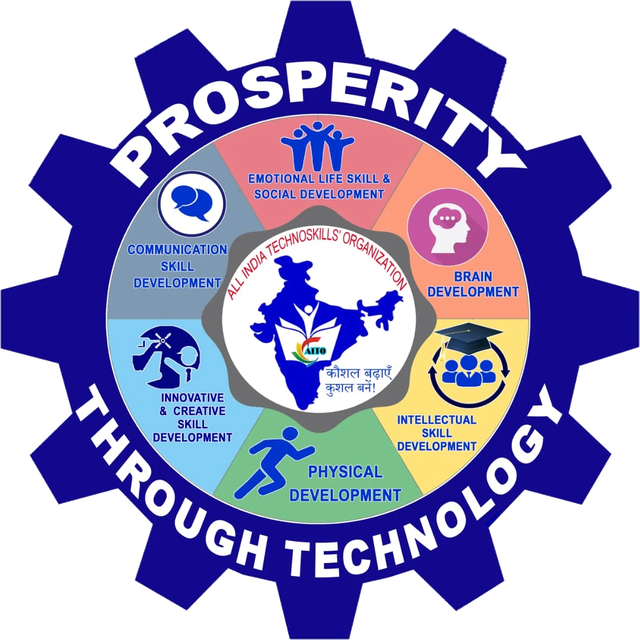
The organization's emblem sets out six areas that together constitute a complete skill. Assessment is framed against them, on the principle that technical ability alone does not make a candidate employable.
Emotional Life Skill & Social Development
Conduct, teamwork and workplace relationships — the competences that determine whether a technically able candidate holds a role and progresses in it.
Brain Development
Reasoning, retention and problem-solving, assessed through applied tasks rather than recall alone.
Intellectual Skill Development
Command of the theory underlying a trade, so that a practitioner can adapt when conditions depart from the textbook case.
Physical Development
Dexterity, stamina and safe working practice, which determine competence in trades performed with the hands and body.
Innovative & Creative Skill Development
The capacity to improve a method, adapt a design or solve an unfamiliar problem within the discipline of the trade.
Communication Skill Development
Clear expression with colleagues, supervisors and customers, in the languages a candidate will actually work in.
कौशल बढ़ाएँ कुशल बनें!
Our Journey
How the organization developed
From a trade-training tradition begun in 1971 to a nationally distributed certification network with digital verification.
1971
Origins in skill education
The organization traces its origin to Akhila Bharata Sanketika Naipunyalu Samstha (ABSNS), formed to extend practical trade training to learners outside the formal academic system.
1990s
Sector councils established
Specialist councils were constituted to define assessment standards trade by trade, rather than applying a single academic yardstick across unrelated skills.
2014
Constituted in its present form
All India Technoskills' Organization was established, registered as a not-for-profit company under Section 8 of the Companies Act 2013, carrying forward the ABSNS tradition under the motto Prosperity through Technology.
2000s
Partner institute network
The authorised centre model was introduced, allowing established training institutes to certify their own students without surrendering their teaching autonomy.
2010s
Catalogue expansion
The programme catalogue grew past 500 certifications spanning information technology, healthcare, construction, beauty, agriculture and renewable energy.
Today
Digital verification
Every issued credential carries a QR code and lives on a public verification portal, so employers and institutions can confirm it without contacting the issuing centre.
Impact
The organization in numbers
- 1971
- Year of Origin
- 22
- Special Councils
- 31
- Skill Sectors
- 548
- Certification Programs
- 1,200+
- Partner Institutes
- 2.4 Lakh+
- Students Certified
Continuing the ABSNS skill-education tradition
Sector expert bodies governing assessment
From IT and healthcare to renewable energy
Certificate through master diploma
Authorised centres nationwide
Skill credentials awarded
Leadership
Offices of the organization
AITO is administered through defined offices, each accountable for a distinct part of the certification chain.
Office of the Chairman
Chairman & Governing Council
Sets the organisation's policy direction, approves sector councils and represents AITO before institutional and industry stakeholders.
Office of the Secretary General
Secretary General
Leads day-to-day administration, partner institute relations and the national expansion of the authorised centre network.
Controller of Assessments
Assessment & Results
Owns the assessment protocol, question banks, assessor coordination, result processing and the integrity of every issued credential.
Directorate of Skill Sectors
Curriculum & Sector Standards
Maintains the 31 sector frameworks and 548 programme syllabi in consultation with the special councils and industry practitioners.
Directorate of Partner Affairs
Institutional Partnerships
Handles applications, centre verification, onboarding, branding compliance and ongoing support for partner institutes.
Records & Verification Cell
Credential Records
Maintains the permanent certificate register and operates the public verification and download portal.
Organizational Structure
How the organization is arranged
Policy, standards, assessment and records are deliberately separated, so that no single office both sets a standard and certifies against it unchecked.
Governing Council
The apex policy body. Approves sector councils, ratifies the programme catalogue and oversees the organization's compliance position.
Council of Technoskills Education & Training
The assessment and training council named on issued credentials, working through sector expert bodies drawn from industry and academia. Each owns the skill standards, syllabus and assessment criteria for its trades.
Assessment Directorate
Maintains question banks, appoints and briefs assessors, processes results and controls the issue of every certificate and marks memo.
Partner Affairs Directorate
Handles applications, verifies institute credentials, issues centre codes and supports partners through onboarding and beyond.
Records & Verification Cell
Custodian of the permanent credential register and operator of the public verification and download portal.
Regional Coordination Offices
State and zonal coordination for centre inspection, assessment scheduling and certificate despatch across the partner network.
Sector coverage under the special councils
31 sectors, grouped into 6 catalogue divisions.
- Computer & Information Technology93
- Hair, Beauty Culture & Spa35
- Fashion Designing, Tailoring & Dress Making24
- Dance, Music & Yoga Health Sciences17
- Art, Drawing & Painting15
- Photography Industry16
- Printing Technology11
- Handicraft Technology11
- Hospitality18
- Bakery, Confectionery & Food Processing29
- Plastic Technology Industry11
- Refrigeration & Air Conditioning4
- Gold Appraiser Technology19
- Automotive Technology17
- Fishery Science Technology8
- Cottage Technology Industry25
- Electrical & Electronics12
- Building & Construction Technology15
- Agriculture & Allied Technology19
- Advertising & Media Technology9
- Veterinary Technology7
- Textile Technology10
- Indian Sweets, Snacks & Food6
- Travel & Tourism9
- Courier & Logistics6
- Insurance Sales3
- Renewable Energy10
- Summer & Winter Vacation Programs50
- Fire & Safety8
- Indian & Foreign Languages8
- Allied Health Care23
Recognition & Compliance
Our statutory position, stated plainly
Corporate registration
AITO is registered as a not-for-profit organisation under Section 8 of the Companies Act 2013 with the Ministry of Corporate Affairs, Government of India, under registration number U74900TG2014NPL096292.
- Registered under
- Companies Act 2013, Section 8
- Registering authority
- Ministry of Corporate Affairs, Government of India
- Registration number
- U74900TG2014NPL096292
- Entity type
- Not-for-profit company
AITO publishes its organizational records, programme schedules and partnership terms in the public document library so that any institute can review them before applying. We think a certification body that asks institutions to trust it should make that review easy.
We are equally direct about what AITO is not. The certificates we issue attest to assessed practical competence in a defined skill. They are not academic degrees, and we do not represent them as such to students, institutes or employers.
AITO is a skill-certification organisation and is not a university. Programmes offered are skill and vocational certification programmes; they do not lead to any degree and are not approved by the UGC, AICTE or DEC. Certificates attest to assessed practical skill competence.